

Two companies grow revenue by 20%.
One expands margins and generates more free cash flow.
The other spends aggressively, issues shares and consumes more capital.
The headline is the same:
Revenue +20%
The economics are not.
That is the problem with using growth as a conclusion.
Growth tells you that the business is getting bigger.
It does not tell you how it is getting bigger, what that growth costs, or what shareholders receive from it.
The growth rate tells you how fast the business is getting bigger. It does not tell you what that growth is worth.
Start with where the growth came from
Revenue can grow for very different reasons.
A company may grow because it:
sold more units;
raised prices;
added customers;
increased spending from existing customers;
launched a new product;
entered a new market;
acquired another company.
All of those can produce the same headline growth rate.
But they do not tell the same story.
Suppose revenue rises:
20%
If most of that came from higher prices while unit volumes were flat, the business may be relying on pricing power.
If it came from higher volumes, demand may be expanding.
If it came from an acquisition, the company may have bought part of the growth rather than creating it organically.
The first useful question is therefore not:
How fast did revenue grow?
It is:
What produced the growth?
The answer can matter more than the headline percentage.
Growth has a cost
Companies rarely grow for free.
Growth may require:
sales and marketing expense;
research and development;
new employees;
inventory;
factories;
data centers;
stores;
customer incentives;
acquisitions;
working capital.
That means the same 20% growth rate can require very different amounts of capital.
Imagine two companies.
Company A
Revenue growth: 20%
Incremental capital required: low
Company B
Revenue growth: 20%
Incremental capital required: high
Both got bigger at the same rate.
But Company A may have created that growth much more efficiently.
That is why growth should be read together with capital efficiency.
A business that needs to reinvest almost everything it earns just to maintain growth can have very different economics from one that can grow while producing excess cash.
Margins show what happens as the business scales
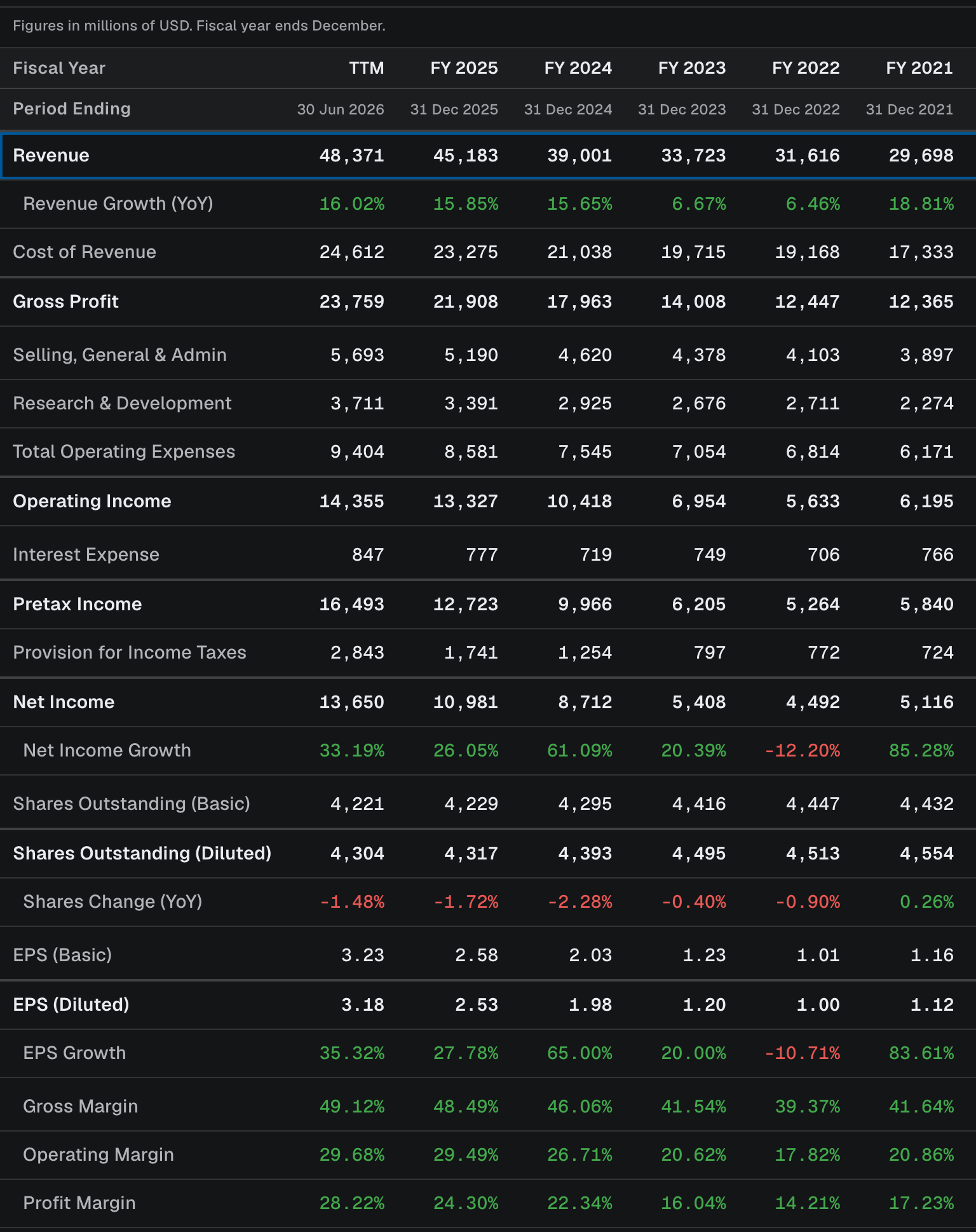
Revenue growth becomes more informative when you ask what happened to profitability at the same time.
Suppose a company grows revenue by:
20%
and operating margin moves:
12% → 16%
The business is not only getting larger.
It is becoming more profitable on each dollar of revenue.
Now imagine another company with the same 20% revenue growth, but operating margin moves:
12% → 7%
The growth is still real.
But the company is spending much more aggressively to produce it.
That may be completely rational if management is investing into a large opportunity.
Or it may show that the economics are weakening.
The point is not that margin expansion is always good and margin compression is always bad.
The point is that growth and profitability need to be read together.
A business can grow quickly while its economics improve, stay flat or deteriorate.
The revenue number alone cannot tell you which one is happening.
ROIC tells you how much the growth requires
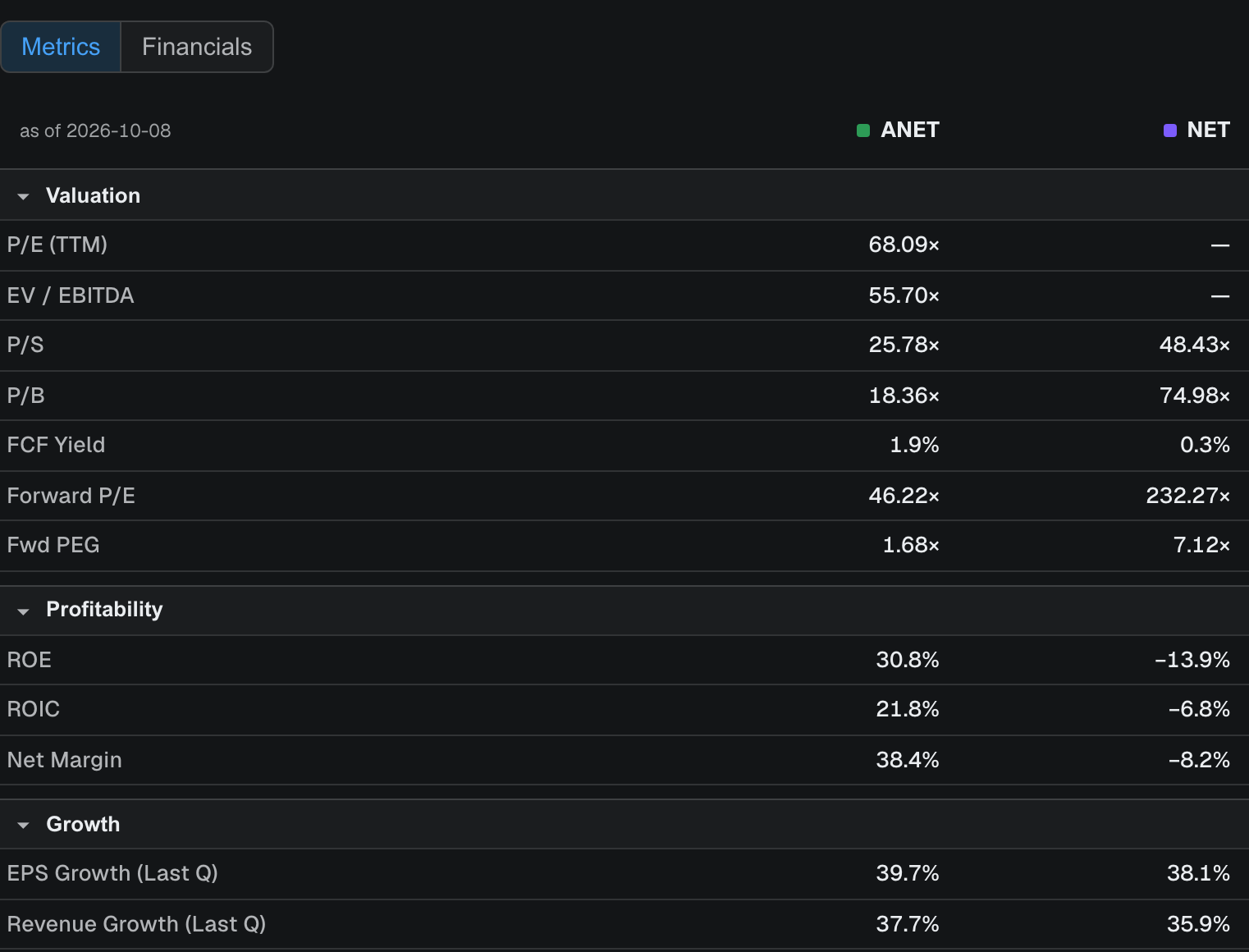
This is where return on invested capital becomes useful.
ROIC asks, broadly:
How effectively does the business turn invested capital into operating profit?
That makes it a natural companion to revenue growth.
Consider two businesses.
Company A
Revenue growth: 15%
ROIC: 25%
Company B
Revenue growth: 15%
ROIC: 7%
The top-line growth is identical.
The capital efficiency is not.
Company A may be able to grow without committing large amounts of additional capital.
Company B may need substantially more investment to produce the same rate of growth.
This is why growth quality becomes especially interesting when you ask:
How much capital is required?
What return does that capital earn?
Can those returns be sustained?
Can the company keep reinvesting at similar returns?
A company with high returns on capital and a long runway to reinvest can have very different economics from one that grows by repeatedly adding low-return capital.
The growth rate is only half of the question.
Per-share growth can differ from company growth
There is another layer that is easy to miss.
A company can grow while the economics per share grow more slowly.
Suppose revenue rises:
20%
But the company also increases its share count by:
10%
The business is larger.
But each existing share now represents a smaller percentage of the company than before.
This can happen through:
stock-based compensation;
equity-funded acquisitions;
capital raises;
employee share issuance.
Dilution is not automatically bad.
Issuing shares can be a rational way to fund growth if the capital creates enough value.
But it means investors should distinguish between:
company-level growth
and:
per-share growth
The same idea applies to EPS and free cash flow.
If total earnings rise 15% while the share count rises 12%, the improvement per share is much smaller.
That is why per-share data matters.
Free cash flow is another reality check
Revenue is recorded when sales occur.
Cash generation tells you what remains after the business funds the operations and investment required to support those sales.
That makes free cash flow another useful check on growth quality.
A company can report strong revenue growth while cash flow remains weak because:
receivables are rising;
inventory is building;
capital expenditure is heavy;
customer acquisition costs are high;
the business is still scaling inefficiently.
Again, this does not automatically make the growth bad.
A young company may deliberately sacrifice current cash flow to build infrastructure for future growth.
But the trade-off should be visible.
A useful question is:
What is the company giving up today to produce the growth rate I am seeing?
Sometimes the answer is margin.
Sometimes it is cash.
Sometimes it is capital.
Sometimes it is dilution.
Organic growth and acquired growth are not identical
Acquisitions can make revenue growth look faster.
Suppose a company with $1 billion of revenue buys another company with $200 million of revenue.
The combined business is immediately larger.
But that does not mean the original business grew by 20% organically.
Acquired growth can still create value.
The relevant questions are different:
What did the company pay?
How was the deal financed?
What returns can the acquired business earn?
Are there real synergies?
Did debt rise?
Did the share count increase?
What happened to ROIC after the acquisition?
This is why headline growth should sometimes be split into:
organic growth
and:
growth purchased through acquisitions
The number may look the same.
The economics behind it can be very different.
Growth should eventually create something
A company can invest heavily for years if the opportunity is large enough.
But growth should eventually translate into something economically useful.
That could be:
higher earnings;
stronger margins;
more free cash flow;
higher returns on capital;
greater scale;
a stronger competitive position.
If revenue keeps growing but none of those things improve, the quality of the growth deserves a closer look.
A practical framework is:
1. Where did the growth come from?
Volume, price, customers, new products or acquisitions?
2. What did it cost?
Margins, capex, working capital, marketing or dilution?
3. What happened to returns?
Did ROIC improve, stay stable or deteriorate?
4. What happened per share?
Did EPS and free cash flow per share keep pace with the company?
5. Is the growth becoming more or less efficient?
Is each additional dollar of revenue becoming more valuable?
That is a much richer picture than the headline growth rate alone.
Growth is an input, not a verdict
Revenue growth matters.
It can show that demand is increasing, a market is expanding or a company is taking share.
But the number does not explain itself.
A better set of questions is:
What produced the growth?
What did the company spend to get it?
Did margins improve?
Did free cash flow improve?
Did returns on capital improve?
Did the share count change?
Was the growth organic or acquired?
Can the company keep growing at similar economics?
Good growth is not simply more revenue. It is growth that improves or strengthens the economics of the business over time.
That does not mean every company needs to maximize profit today.
It means the relationship between growth and economics should make sense.
The headline tells you how fast the business expanded.
The research begins when you ask what that expansion required.
I write these notes to explain how the numbers and tools in the workspace are made, how to read them, and where they fit — never to tell you where a market or a stock will go.
Continue with rhope
Find a stock →
Compare companies →
Open Screener →
Sources
The worked examples and the cover chart are illustrative arithmetic. None is a quote for any security.
Screenshots show company figures as displayed in the rhope workspace.
Descriptive only — nothing here is investment advice, a recommendation, or a trading signal. See our Terms.